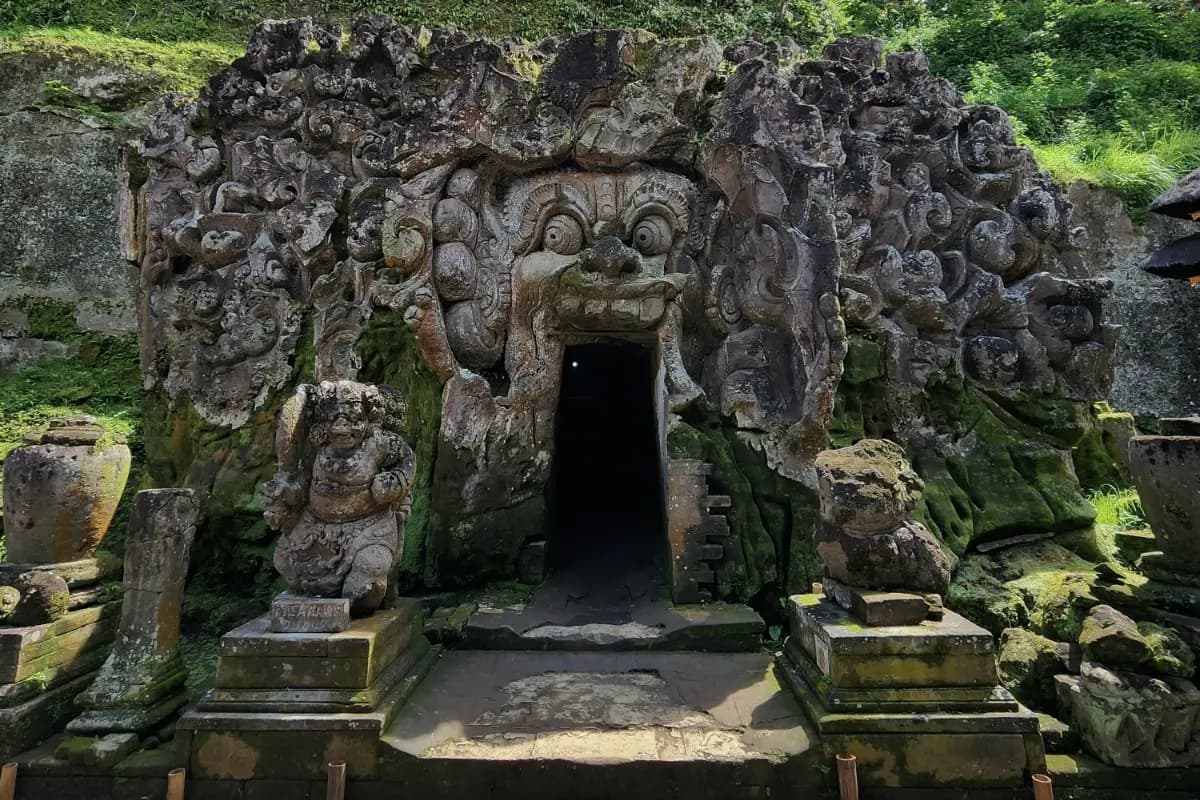
Bali always has a hidden side waiting to be explored, and Goa Gajah is one of those places that can make your holiday even more memorable. More than just a cave, this site holds an ancient place of worship and archaeological remains dating back to the 11th century.
Located in Bedulu Village, Blahbatuh District, Gianyar, the cave is famous for its carved facade resembling a giant face and its ancient bathing pools surrounded by lush gardens. So, is Goa Gajah Bali worth visiting for a different kind of experience? This article will give you a complete guide before you go.
What Is Goa Gajah and Why Is It Called the Elephant Cave?
When people talk about temples and spiritual places in Ubud, Goa Gajah is often not the first name that comes up. Yet this site can make your holiday on the Island of the Gods even more exciting and meaningful.
Goa Gajah, also known as Elephant Cave, is an ancient heritage site and significant temple located in Bedulu Village, Gianyar, Bali. Believed to date back to the 11th century, the site stands out for blending Hindu and Buddhist relics within a single complex.
So, why is it called Elephant Cave? The name has nothing to do with elephants roaming the area, but rather comes from the statue of Lord Ganesha, the elephant-headed god in Hinduism, found inside the cave. Another theory traces the name to Lwa Gajah, an ancient term mentioned in the Negarakertagama manuscript (1365 AD). The phrase refers to a peaceful riverside sanctuary.
The History of Goa Gajah From the Warmadewa Dynasty to Its Rediscovery
Long before it became a tourist favorite, Goa Gajah was a sacred site where Hindu and Buddhist worship took place during the Warmadewa dynasty, which ruled Bali from the 10th to 14th century. You can still see traces of that era today, from the T-shaped cave where priests once meditated, to the bathing pool with six nymph statues whose water is believed to purify anyone who touches it.
The site also tells a story of religious harmony in ancient Bali. Hindu relics like the Ganesha statue stand side by side with Buddhist remains, including a stupa found in the Tukad Pangkung area.
The modern world only took notice in 1923, when a Dutch official named L.C. Heyting reported three statues found at the site: Ganesha, Trilingga, and Hariti. Two years later, archaeologist Dr. W.F. Stutterheim came to study the site more closely.
Another surprise came in 1931, when Conrat Spies found a three-pronged stupa carved into a rock wall that had fallen into the river below. Research picked up again in 1950, after Indonesia’s Archaeological Service opened its Bali office under J.L. Krijgsman.
The biggest discovery came during excavations between 1954 and 1979, when the ancient bathing pool was finally unearthed, along with six angel statues spouting water from their chests. Until now, many visitors believe the water carries a purifying energy.
Earlier digs in the early 1950s also uncovered an old rectangular foundation in front of the cave. Researchers even found stone fragments from the giant face above the cave entrance and a stone sword belonging to the statue guarding the front.
What to See Inside the Goa Gajah Complex
Planning a visit to Goa Gajah Bali and wondering what awaits inside the complex? Here are the highlights you can explore around the site:
- Carved cave entrance: The front of the cave is adorned with carvings of a menacing face and nature motifs, believed to guard everything inside from evil spirits.
- Meditation niches: Inside the cave, you will find small niches once used by Hindu and Buddhist priests for meditation, with the Ganesha statue and Trilingga sitting at the far end.
- Sacred bathing pool: In the front courtyard lies an ancient bathing area with six angel statues pouring water, believed to carry a purifying aura.
- Buddhist relics: Down the valley near the Tukad Pangkung river, you can see the remains of stupas and Buddha statues believed to date back to the 9th and 10th centuries.
- Lush gardens and cliff reliefs: The complex is surrounded by dense tropical greenery, with rock cliffs covered in ancient carved reliefs.
Goa Gajah Location and Distance From Every Part of Bali
As mentioned earlier, Goa Gajah is located in Bedulu Village, Blahbatuh District, Gianyar Regency. The site sits very close to central Ubud, only about 5 km away or a 15 to 20 minute drive.
Travel time to the site depends on where you are staying, whether in Ubud, Denpasar, Kuta, or Seminyak. To give you a picture, here is the distance to Goa Gajah from popular areas in Bali:
- Ubud: Around 5 km, or a 15 to 20 minute drive.
- Denpasar: Around 26 to 30 km, or roughly a 1-hour drive.
- Kuta: Around 35 to 40 km, or about a 1-hour 20-minute drive.
- Seminyak: Around 30 to 35 km, or about a 1 hour 30 minute drive.
Note: Actual distance and travel time may vary depending on your exact location and road conditions, as traffic can make the trip longer.
Entrance Fee, Opening Hours, and Dress Code
Goa Gajah is open to the public every day from 8 AM to 6 PM. The ticket prices vary by visitor category, so here are the details of the Goa Gajah entrance fee:
| Category | Price |
| Domestic Adult | IDR 30,000 / person |
| Domestic Child | IDR 15,000 / person |
| Foreign Adult | IDR 50,000 / person |
| Foreign Child | IDR 25,000 / person |
| Car Parking | IDR 5,000 / car |
| Motorbike Parking | IDR 2,000 / motorbike |
Beyond being a protected heritage site, keep in mind that Goa Gajah is also an active temple (pura) still used by local Hindu communities today. Visitors are expected to dress modestly, with clothing that covers the shoulders and knees.
You will also be asked to wear a sarong (kamen) and a sash (selendang) tied around the waist before entering. Women who are menstruating are not allowed to enter the cave area, following Balinese temple customs.
How Long to Spend at Goa Gajah and the Best Time to Visit
You don’t need much time to explore the Goa Gajah Temple complex in Bali. In just 1 to 1.5 hours, you can enjoy the beauty, uniqueness, and learn about the history, culture, and spirituality this destination has to offer.
During your visit, you can take a leisurely walk through the iconic carved entrance, admire the ancient bathing pools, descend the forested steps to the river, and explore the moss-covered ruins.
For the best experience, visit early in the morning, ideally when the temple opens at 8:00 AM, before it gets too crowded. Without having to squeeze through the crowds, you’ll be able to explore the temple complex more comfortably and at your own pace.
Planning Your Visit by Traveler Type
To make the most of your visit and match your travel style, it’s worth planning your trip to Goa Gajah based on the kind of experience you’re looking for, whether you’re a cultural explorer, a nature and content lover, or a leisure traveler visiting with family.
- Cultural Explorer: If you’re passionate about history and culture, hiring a local guide is highly recommended so you can gain a deeper understanding of the history behind this ancient Hindu and Buddhist heritage site. Don’t miss the ancient bathing pools and the Ganesha statue inside the cave.
- Nature and Content Lovers: If you’re visiting to enjoy the natural surroundings and capture beautiful photos or videos for Instagram or TikTok, come early in the morning at 8:00 AM to avoid the crowds and catch the magical light filtering through the forest. Explore the entire complex and follow the footpath through the cave to the hidden waterfall and river.
- Leisure / Family: If you’re looking for a more relaxed visit or traveling with your family, you can come at any time of the day. Take your time enjoying the cool atmosphere and shady trees, then browse for local handicraft souvenirs at the stalls near the site’s parking area.
Nearby Temples to Pair With Goa Gajah in One Trip
Beyond Goa Gajah Temple (Pura Goa Gajah), Gianyar is home to many other fascinating temples worth exploring. Since several of them are located just a short drive away, you can easily visit another temple before or after Goa Gajah and enjoy a richer cultural journey.
- Tirta Empul Temple (14 km, around 35 minutes) is best known for its sacred spring water, where Balinese Hindus perform the traditional melukat purification ritual. It offers a unique opportunity to witness a living cultural tradition that continues to be practiced today.
- Puseh Desa Batuan Temple (10 km, around 20 minutes) dates back to 1022 AD and is renowned for its distinctive Balinese architecture and intricate stone carvings. With an atmosphere that differs from Goa Gajah, it’s a wonderful place to experience another side of Bali’s spiritual and cultural heritage.
- Gunung Kawi Sebatu Temple (17 km, around 30 minutes) offers a much quieter setting, complete with natural spring pools, lush gardens, and towering tropical trees. It’s an ideal stop if you’re looking to unwind and enjoy the peaceful side of Bali.
Other Central Ubud Attractions Worth Combining With Your Visit
Besides pairing your visit with other temples in Gianyar, Goa Gajah’s location just 5 km from the center of Ubud makes it easy to combine your itinerary with some of the area’s most iconic attractions.
- Sacred Monkey Forest Sanctuary: This protected forest is home to hundreds of long-tailed macaques and the sacred Mandala Suci Wenara Wana Temple. Walk beneath towering trees, observe the monkeys in their natural habitat, and experience the forest’s unique spiritual atmosphere.
- Ubud Palace (Puri Saren Agung): The official residence of Ubud’s royal family and one of the town’s most important cultural landmarks. Built in the 19th century, the palace is known for its beautiful Balinese architecture and its role in preserving the island’s arts and traditions. It’s an ideal place to admire the architecture, enjoy a leisurely stroll, and learn more about Ubud’s history.
- Ubud Art Market: If you’re looking for what to do in Ubud, spending time at the Ubud Art Market is a must. Browse handcrafted souvenirs made by local Balinese artisans, sample delicious local food, and soak up the vibrant atmosphere of one of Ubud’s most iconic shopping destinations.
- Campuhan Ridge Walk: This scenic walking trail winds across rolling green hills with sweeping valley views. It’s the perfect place for a leisurely walk, capturing beautiful photos, or enjoying the sunrise and sunset in one of Ubud’s most peaceful settings.
Where to Eat in Ubud After Visiting Goa Gajah
Ending your day with a great meal in a relaxing setting is one of the best ways to wrap up your visit to Goa Gajah and its nearby attractions. Ubud’s culinary scene is just as diverse as its landscapes, offering everything from elegant jungle restaurants and authentic Japanese cuisine to humble local eateries serving traditional Balinese flavors.
- Norii Ubud: If you’re craving authentic Japanese cuisine, Norii Ubud is a must-visit after exploring Goa Gajah. Located less than 2 km away, the restaurant is known for its fresh sushi and a wide selection of flavorful yakitori, making it the perfect place to recharge after a day of sightseeing.
- Habitat Bistro: Located on Jalan Bisma No. 888A, around 4.3 km from Goa Gajah, Habitat Bistro is a jungle restaurant in Ubud serving modern Italian fusion cuisine with handmade pasta and wood-fired pizza. Surrounded by lush tropical greenery and overlooking a tranquil pool, it’s the perfect place to unwind while enjoying one of Ubud’s most scenic dining settings.
- Shichirin Ubud: Situated on Jalan Bisma No. 888X, less than 5 km from Goa Gajah, Shichirin Ubud is another excellent choice for Japanese food lovers. The restaurant is especially known for its interactive dining experience, where you can watch skilled chefs prepare premium ingredients such as wagyu beef and fresh seafood right before your eyes.
- Ubud Night Market: If you’re searching for authentic Ubud culinary experiences on a budget, visiting one of Ubud’s night markets is a great option. Explore local favorites such as Pelitan Night Market, Sayan Night Market, Ubud Street Market, and Senggol Market Kedewatan, where you can sample a variety of authentic Balinese street food.
- Sawah Indah Resto: For a meal with beautiful rice field views close to Goa Gajah, Sawah Indah Resto is highly recommended. The restaurant specializes in authentic Balinese and Indonesian cuisine, with signature dishes including Bebek Timbungan, crispy duck, and grilled gourami, all served in a peaceful countryside setting.
Turning Goa Gajah Into a Complete Ubud Day
Visiting Goa Gajah is more than just exploring one of Bali’s historic landmarks. Its convenient location near many attractions in Ubud and Gianyar makes it the perfect starting point for a full day of discovering temples, nature, art, and local culinary experiences.
Goa Gajah is a destination that’s always worth adding to your Bali itinerary. If you’re looking for more travel inspiration, visit The Wonderspace to explore curated Bali travel guides, itinerary ideas, and recommendations for families, couples, and groups.